

SAMPLE EMAIL:
Feel free to personalize this message. Legislators are most influenced by hearing directly from constituents in their own words.
Subject: Please Bring H.4539 to a Vote
Dear Senate President Spilka,
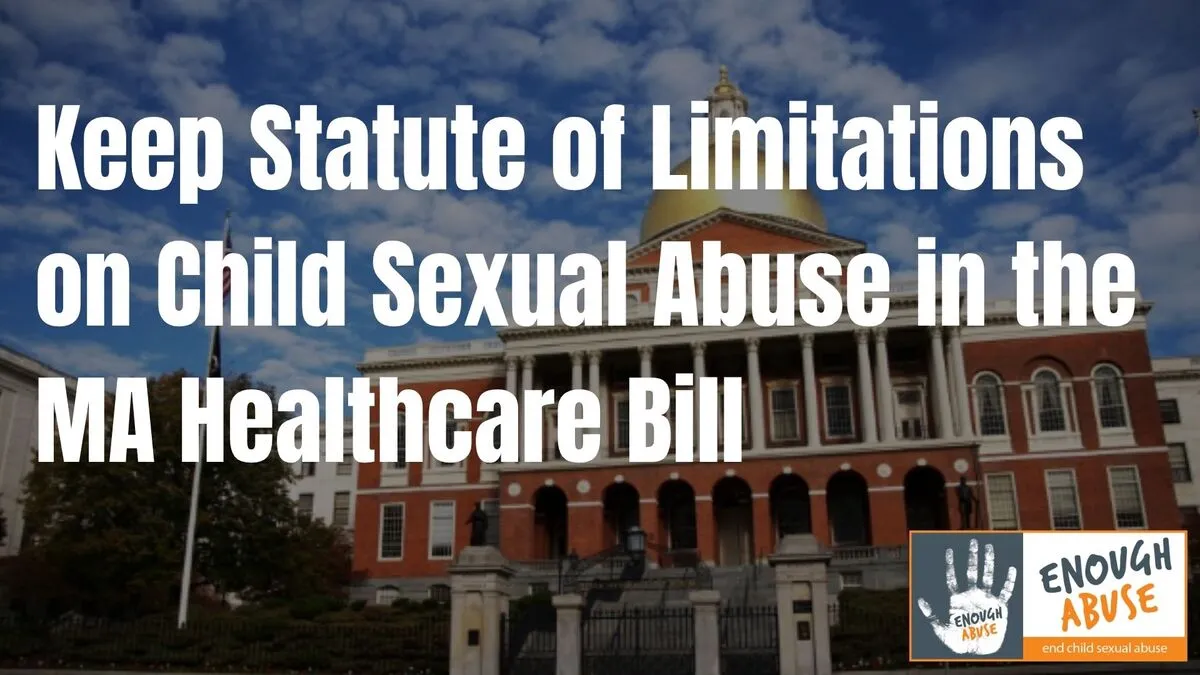
I am writing to respectfully ask you to bring H.4539, An Act Enhancing Remedies for Survivors of Childhood Sexual Abuse, to the Senate floor for a vote before the legislative session concludes.
Survivors of childhood sexual abuse often need years—or even decades—to come forward. Trauma does not follow a legal timeline, and our laws should reflect that reality.
H.4539 would provide survivors with a meaningful opportunity to seek justice by eliminating the civil statute of limitations for childhood sexual abuse claims, creating a two-year revival window for previously time-barred claims, removing the governmental notice requirement, and eliminating the outdated $20,000 charitable immunity cap that limits institutional accountability.
Massachusetts has long been a leader in protecting civil rights and advancing justice. I respectfully ask that our Commonwealth continue that legacy by ensuring H.4539 receives a vote this session.
Survivors have waited long enough.
Thank you for your leadership and for your consideration of this important legislation.
Respectfully,
[Your Name]
[City or Town], Massachusetts

Sample Email:
Subject: Please Support H.4539
Dear Representative,
As your constituent, I respectfully ask you to support H.4539, An Act Enhancing Remedies for Survivors of Childhood Sexual Abuse.
This legislation recognizes that trauma does not follow a legal timeline. Many survivors need years—or even decades—before they are able to come forward. H.4539 would help ensure that survivors have a meaningful opportunity to seek justice while strengthening accountability for institutions that enabled abuse.
The bill also addresses Massachusetts’ outdated and unacceptable $20,000 cap on damages for charitable organizations in cases involving childhood sexual abuse. Massachusetts is one of only a handful of states that still maintains such a low cap. As a result, well-funded institutions—including churches, hospitals, and other nonprofits with substantial insurance coverage—can shield themselves behind this outdated law. The cap limits accountability, minimizes the harm suffered by survivors, and weakens the incentive for institutions to take meaningful steps to prevent abuse from occurring in the first place.
Massachusetts can and should do better. Survivors deserve meaningful access to justice, and institutions that fail to protect children should be held fully accountable for the consequences of their actions.
I respectfully ask that you support H.4539 and encourage House leadership to bring this important legislation to the House floor for a vote.
Thank you for your service and for standing with survivors.
Sincerely,
[Your Name]
INSTITUTION ACCOUNTABILITY
KATIE MEYER’S LAW
Katie’s story has inspired state and federal legislation aimed at protecting college students.
Nationally, H.R. 5545: Katie Meyer’s Law, sponsored by Julia Brownley, has been introduced in Congress but has not yet been passed.
The proposed law would:
- Ensure students have the right to an independent advisor during disciplinary proceedings
- Provide critical support during high-stress institutional processes
- Establish reporting requirements for campus suicide incidents
- Promote greater accountability and transparency
Katie Meyer’s Law is rooted in a simple but critical principle: students should not have to face these moments alone.
How you can help:
You can help move Katie Meyer’s Law forward.
- Find your representatives:
https://www.congress.gov/members/find-your-member - Email Your Representatives
Subject: Support for H.R. 5545 – Katie Meyer’s Law
Ask them to support legislation that protects students and strengthens mental health safeguards. (see sample) - Call Your Representatives
A short call can make a real impact. Share why this issue matters and urge support for H.R. 5545.

Sample Email
Dear [Salutation]:
As a constituent from [City, State, Zip Code], I am writing to urge you to support H.R. 5545, Katie Meyer’s Law. This law is inspired by the life of Katie Meyer, whose tragic passing underscored the urgent need for greater protections and support for our college students. Katie Meyer’s Law will ensure students at higher education institutions have the right to select an independent adviser to help them navigate disciplinary proceedings when facing an alleged violation of the student code of conduct. It will also create new reporting requirements for campus suicide incidents. The college experience is a vital and formative time – but also a time when these young adults may feel alone or unsupported. Protecting the mental well-being of students during this vulnerable period is essential. I urge your support for H.R. 5545.
Thank you for your consideration.
Regards,
[Your Name]
SEXUAL ASSAULT
VIRGINIA’s LAW
“Virginia’s Law” is proposed federal legislation introduced in February 2026 by Senate Majority Leader Chuck Schumer and Representative Teresa Leger Fernández to eliminate civil statutes of limitations for adult victims of sexual abuse and sex trafficking.
Key Details of Virginia’s Law:
Purpose: Allows survivors of sexual abuse and trafficking to file civil claims against their abusers regardless of when the abuse occurred.
Origin: Named in honor of the late Virginia Roberts Giuffre, a prominent survivor and advocate of the Jeffrey Epstein abuse network.
Scope: Targets civil suits in federal court, removing the ability for powerful abusers to use time expiration dates as a shield against accountability.
The legislative push was announced on Capitol Hill alongside Epstein survivors and Giuffre’s family members. The effort runs parallel to demands for greater transparency in government files relating to the Epstein case.

Sample Email
Dear Senator/Congressperson [Last Name],
As a constituent from [City, State, Zip Code], I am writing to urge you to support VIRGINIA’s LAW, the proposed federal legislation that would eliminate civil statutes of limitations for adult survivors of sexual abuse and sex trafficking.
For far too long, survivors have been denied justice simply because trauma, fear, manipulation, or power imbalances prevented them from coming forward within an arbitrary timeframe. Many survivors need years, sometimes decades, to fully process what happened to them and feel safe enough to speak out.
VIRGINIA’s LAW recognizes this reality and ensures that powerful abusers can no longer hide behind expired deadlines to escape accountability.
Named in honor of Virginia Roberts Giuffre, whose courage helped expose one of the most notorious trafficking and abuse networks in recent history, this legislation represents an important step toward justice, transparency, and survivor empowerment.
No survivor should lose their right to seek accountability because the system failed to understand the lasting impact of trauma.
I respectfully ask you to publicly support and vote in favor of VIRGINIA’s LAW. Survivors deserve the opportunity to be heard, no matter how much time has passed.
Thank you for your time and consideration.
Regards,
[Your Name]
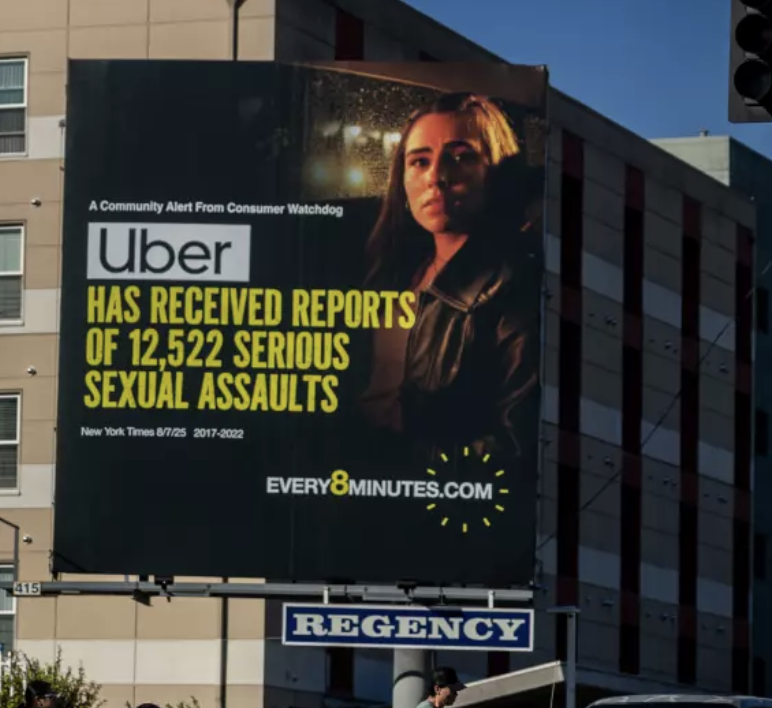
UBER ON THE BALLOT IN CALIFORNIA IN NOVEMBER
California voters will directly decide on major ride-hailing liability legislation regarding sexual misconduct. A proposed ballot measure – backed by over 1.1 million submitted signatures – seeks to hold companies like Uber legally responsible for sexual assaults by drivers and mandate stringent, public reporting requirements.
The push for legislative and policy changes addresses the thousands of lawsuits accusing ride-share platforms of failing to protect passengers. Key elements of this movement include:
The 2026 Ballot Initiative: The California Require Background Checks and Sexual Assault Reporting by Rideshare Companies Initiative aims to require ride-share companies to publish misconduct occurrences monthly on their websites and report them to the California Public Utilities Commission (CPUC).
Liability Expansion: The measure would require ride-hailing apps to conduct more rigorous background checks, share internal risk assessment scores or hazard ratings with users before pairing, and legally hold the companies accountable for sexual assault or misconduct that occurs during trips.
Common Carrier Duties: In federal multidistrict litigation (MDL), a California federal judge ruled that Uber qualifies as a “common carrier.” This designation means the company has a heightened, non-delegable duty to ensure passenger safety, establishing a precedent that they can be held directly liable for driver misconduct.
Mandatory Reporting Laws: Existing California law and regulations already require ride-share companies to submit annual reports to the CPUC detailing the number of sexual assault claims and to immediately suspend drivers accused of violations. However, advocacy groups and the California Department of Justice have previously clashed with platforms over the transparency and disclosure of these exact reports.
For a closer look at the pending state ballot language, you can review the official text on the California Secretary of State page. You can also track the measure’s full requirements via Ballotpedia.